
Blog · Garden style guides
Evergreen Garden
Evergreen garden design for the Pacific Northwest.
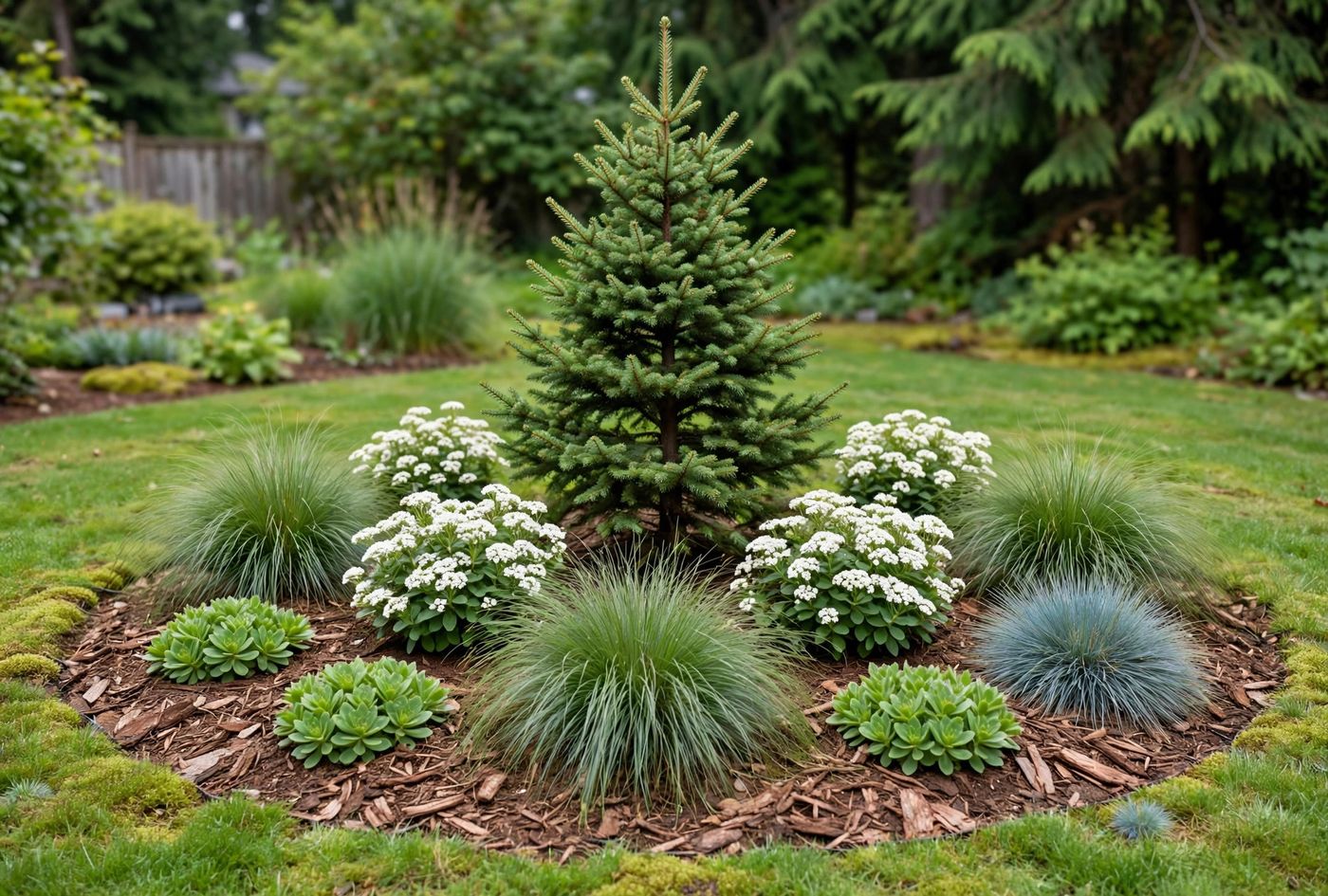
An evergreen garden is built for the other nine months. When the perennials are asleep and the deciduous shrubs are bare sticks, this garden is still standing there in February looking like a garden — layered greens, sculptural conifers, winter flowers, and foliage in blue, gold, bronze and deep green. It is the backbone style of the Pacific Northwest, where evergreen natives and broadleaf evergreens thrive in our acid soil and mild winters.
Evergreen does not mean a row of identical arborvitae. The craft is in mixing textures and tones: fine needles against broad glossy leaves, a blue spruce behind gold-thread cypress, winter-blooming heather and sarcococca carrying fragrance when nothing else dares to flower. Add a few deciduous accents for fall color and spring bloom and the garden never sits still.
Design moves that make it work
- Work in at least three green tones — deep green, blue-green and gold or variegated — so the planting reads in layers.
- Mix textures on purpose: needle conifers, broadleaf shrubs (pieris, camellia, rhododendron), and fine grasses or heathers.
- Plant winter performers where you see them daily: sarcococca by the door, heather along the walk, hellebores under windows.
- Give conifers their mature width on paper; crowding young evergreens is the most common evergreen-garden mistake.
Plant combinations that work
Individual plants are easy; combinations are the design. Three proven groupings for this style — and how each one sits in the layout:
- The winter bones — Prelude Japanese pieris, Winterglow bergenia, Kinnikinnick. Pieris bells open in March, bergenia leaves go bronze-red all winter, and kinnikinnick holds its red berries underneath both.
- The texture trio — Slender hinoki cypress, Otto Luyken cherry laurel, Russian cypress. Cypress sprays, glossy laurel leaves and feathery Russian cypress — three textures that still read as layers in January.
- The fragrant entry — Mexican orange blossom, Candytuft, Kinnikinnick. Orange blossom perfumes the door in spring, candytuft whites the edge, kinnikinnick keeps the ground green year-round.
Signature plants
From the YardCanvas Pacific Northwest plant library — 42 plants carry the Evergreen Garden style:
- Arctostaphylos uva-ursi Arctostaphylos uva-ursi
- Carex testacea Carex testacea
- Mahonia repens Mahonia repens
- Arbutus unedo ‘Compacta’ Arbutus unedo
- Mahonia nervosa Mahonia nervosa
- Bergenia cordifolia ‘Winterglow’ Bergenia cordifolia
- Pennisetum alopecuroides ‘Little Bunny’ Pennisetum alopecuroides
- Pennisetum alopecuroides ‘Moudry’ Pennisetum alopecuroides
- Carex morrowii ‘Ice Dance’ Carex morrowii
- Liriope muscari ‘Majestic’ Liriope muscari
Browse the full Plant Library for sizes, sun and water needs.
In the Pacific Northwest
Zones 8b–9a are evergreen heaven — camellias, pieris, rhododendrons and most conifers are fully hardy and love our rain. Watch drainage in heavy clay, and water new evergreens through their first two summers; after that, most coast along on rainfall.
Maintenance, honestly
No garden is no-maintenance. Here is the real rhythm for this style, season by season:
- Spring: Feed acid-lovers lightly; prune conifers only to shape, never top them.
- Summer: Water young evergreens deeply in drought; established ones mostly coast.
- Fall: Plant new evergreens now — warm soil, cool air is their favorite start.
- Winter: Shake heavy snow off broadleaf evergreens before branches bend.
Getting the layout right
Because evergreens are permanent, the plan matters more here than anywhere: YardCanvas places each plant at mature spread and balances the winter picture first, then layers seasonal color into the gaps.