
Blog · Garden style guides
Japanese Style Garden
Japanese style garden design.
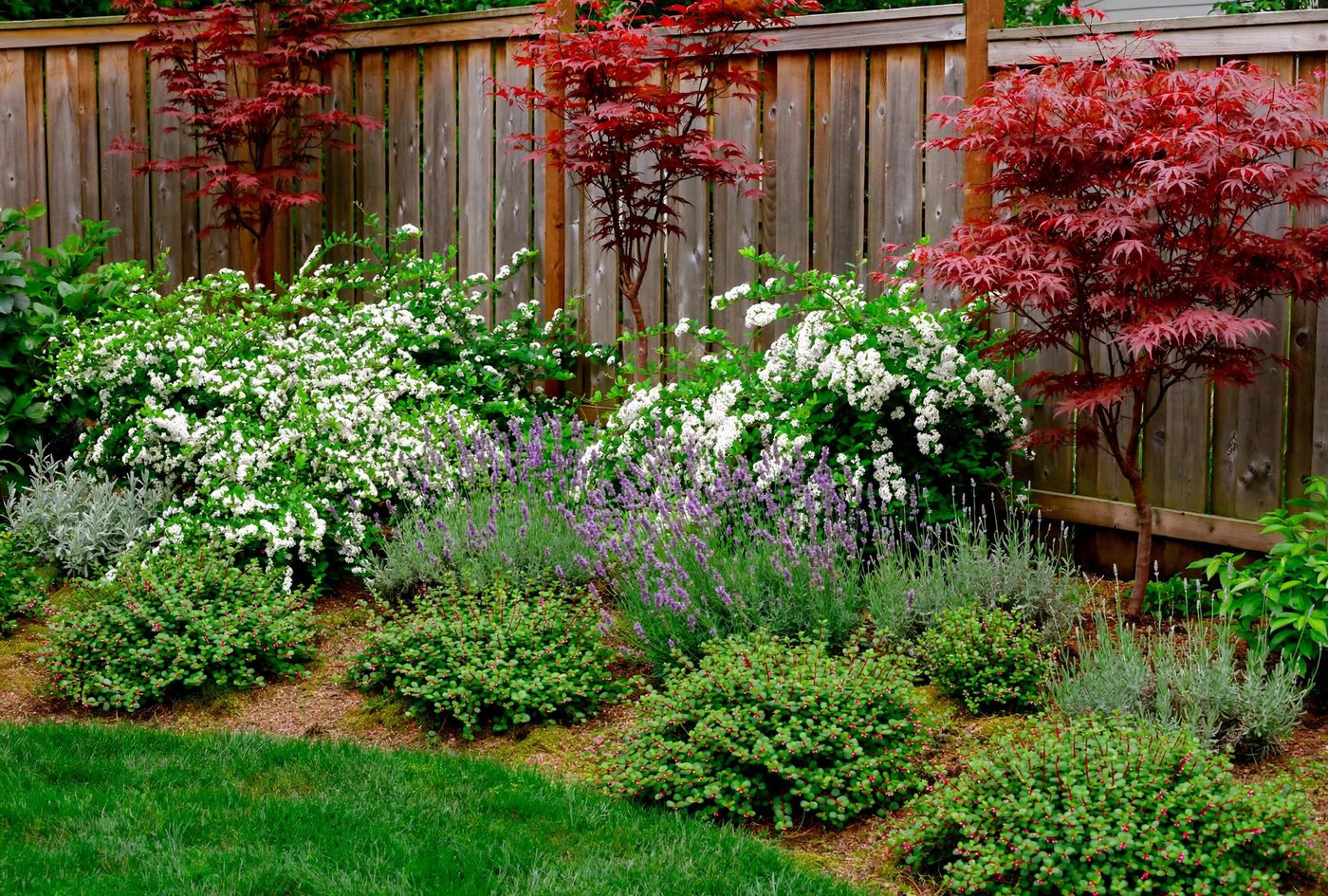
A Japanese style garden is an exercise in restraint. Every plant is placed, pruned and given room to be seen: a sculptural Japanese maple, a cloud-pruned pine, moss and groundcover flowing like water around stone. Color is quiet — greens in a dozen shades, white and pale pink blooms, and the famous fall fire of the maples. The space between plants matters as much as the plants; that emptiness is what makes it feel calm instead of empty.
You do not need a tea house or a raked gravel sea to borrow the style. A single corner — maple, stone, ferns, a stone lantern — can carry the whole mood, and the style scales from a courtyard to a full backyard. It also suits our climate uncannily well: the Pacific Northwest is one of the few places outside Japan where these plants genuinely thrive.
Design moves that make it work
- Choose one hero tree and give it a stage: a Japanese maple with space around it beats five crowded together.
- Layer like a forest edge — canopy tree, sculptural shrub, then ferns, hostas and moss-like groundcover below.
- Use odd numbers and asymmetry; place stones and plants off-center, in triangles, never in straight rows.
- Prune for shape, not size: open the centers of shrubs so their branch structure shows.
Plant combinations that work
Individual plants are easy; combinations are the design. Three proven groupings for this style — and how each one sits in the layout:
- The maple stage — Coral bark Japanese maple, Japanese pieris, Western sword fern. One maple given room to perform, pieris beneath it, ferns flowing out like water from the trunk.
- The quiet floor — Japanese spurge, Tassel fern, Lenten rose. A living floor of spurge and fern under the shrubs, hellebores flowering through it in the darkest months.
- The sculptural pair — Slender hinoki cypress, Dwarf sweet box, Golden Japanese forest grass. Upright cypress against mounded sweet box, golden grass spilling between them like light.
Signature plants
From the YardCanvas Pacific Northwest plant library — 27 plants carry the Japanese Style Garden style:
- Mahonia repens Mahonia repens
- Pachysandra terminalis Pachysandra terminalis
- Pieris japonica ‘Prelude’ Pieris japonica
- Polystichum munitum Polystichum munitum
- Acer palmatum ‘Sango-Kaku’ Acer palmatum
- Blechnum spicant Blechnum spicant
- Helleborus orientalis Helleborus orientalis
- Polystichum polyblepharum Polystichum polyblepharum
- Sarcococca hookeriana var. humilis Sarcococca hookeriana var. humilis
- Acer shirasawanum ‘Aureum’ Acer shirasawanum
Browse the full Plant Library for sizes, sun and water needs.
In the Pacific Northwest
Japanese maples, pieris, azaleas, bamboo (clumping only), ferns and moss all love PNW acid soil and rain. The cautions: maples scorch in hot afternoon sun and wind, so give them morning sun and shelter; and plant in free-draining soil — wet feet in winter is the main killer here.
Maintenance, honestly
No garden is no-maintenance. Here is the real rhythm for this style, season by season:
- Spring: Prune maples and shrubs for shape while structure is visible; refresh gravel.
- Summer: Hand-weed — the calm depends on clean ground; water deeply in heat.
- Fall: Rake leaves off moss and groundcover promptly so they don't smother.
- Winter: Prune pines and open shrub centers on dry days; admire the bones.
Getting the layout right
On paper, a Japanese garden is mostly negative space, and that is where a measured plan earns its keep: YardCanvas sizes the open areas as deliberately as the planting, so the calm is built in, not left to chance.