
Blog · Garden style guides
Low Maintenance Plants
Low maintenance garden design for busy PNW homeowners.
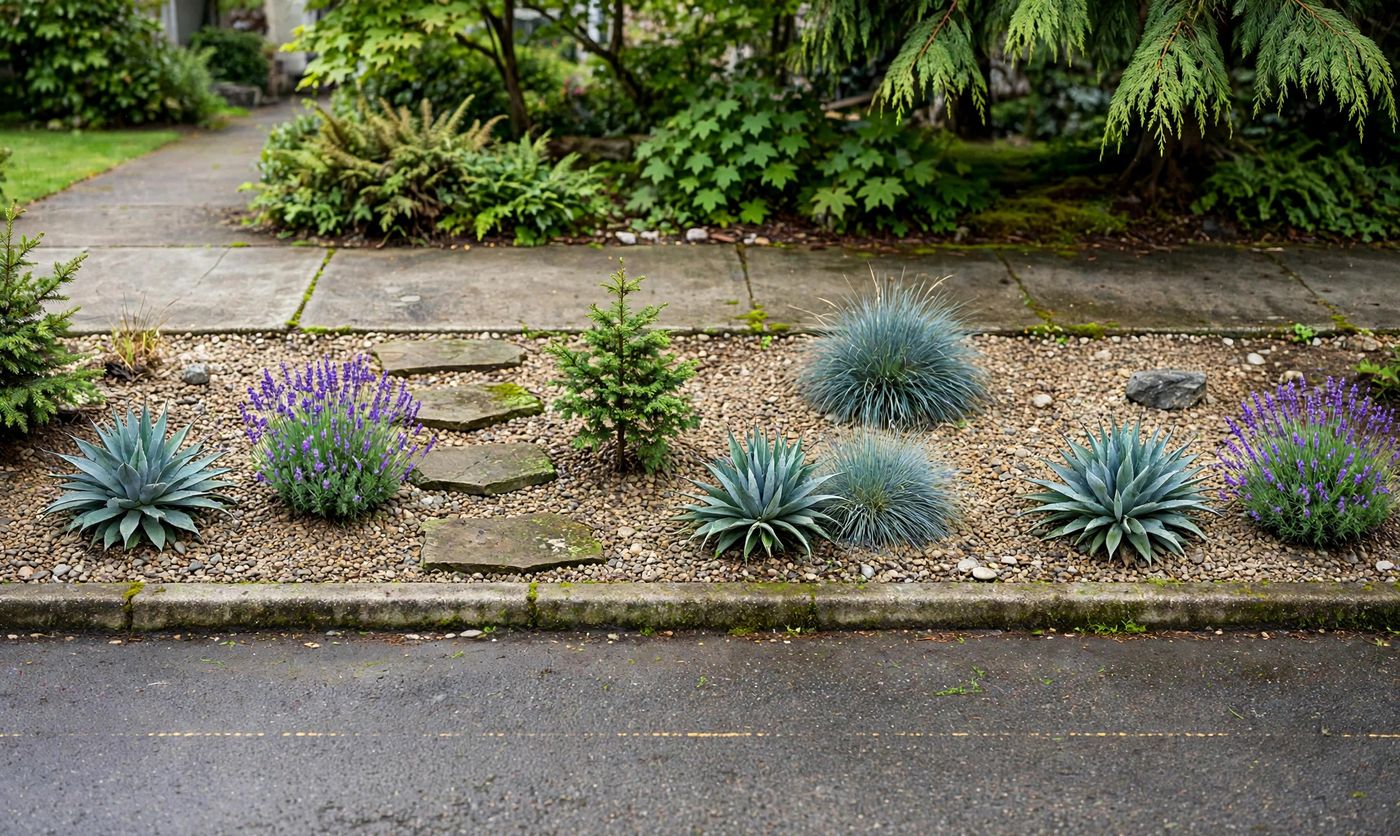
A low maintenance garden is not a gravel pit with three sad shrubs — it is a planting chosen so the plants do the work. The right palette covers its own ground (so weeds and mulch chores shrink), holds its shape without constant pruning, shrugs off a dry August, and still looks deliberate in February. The trick is selection, not effort: slow-growing evergreens, mounding shrubs that keep a tidy outline, ornamental grasses that only need one cut a year, and groundcovers that knit into living mulch.
This is the style most of our customers actually want, whatever they call it. It suits rental properties, busy families, second homes, and anyone whose weekends are spoken for. Done well, it needs a spring tidy, a fall tidy, and almost nothing in between.
Design moves that make it work
- Choose plants at their mature size — a shrub that wants to be 4 feet in a 4-foot space never needs pruning.
- Cover the ground: groundcover or a 3-inch mulch layer is the difference between weeding weekly and weeding twice a year.
- Favor evergreen structure (roughly two-thirds of the bed) so the garden looks finished in winter, not just June.
- Group plants by water need so one drip zone or one hose pass serves the whole bed.
Plant combinations that work
Individual plants are easy; combinations are the design. Three proven groupings for this style — and how each one sits in the layout:
- The set-and-forget border — Karl Foerster feather reed grass, Winterglow bergenia, Kinnikinnick. One grass for movement, bergenia's evergreen leaves for winter, kinnikinnick sealing the ground — nothing here needs staking, dividing or fussing.
- The groundcover seal — Japanese spurge, Blue oat grass, Kinnikinnick. Spurge and kinnikinnick knit the soil shut under the shrubs, so weeds never get a foothold; blue oat grass adds one architectural note.
- The four-season mound — Slender hinoki cypress, Amethyst Mist coral bells, Emerald Blue creeping phlox. A slow conifer that never needs pruning, coral bells for foliage color, creeping phlox carpeting the spring edge.
Signature plants
From the YardCanvas Pacific Northwest plant library — 59 plants carry the Low Maintenance Plants style:
- Arctostaphylos uva-ursi Arctostaphylos uva-ursi
- Carex testacea Carex testacea
- Mahonia repens Mahonia repens
- Arbutus unedo ‘Compacta’ Arbutus unedo
- Mahonia nervosa Mahonia nervosa
- Bergenia cordifolia ‘Winterglow’ Bergenia cordifolia
- Pennisetum alopecuroides ‘Little Bunny’ Pennisetum alopecuroides
- Pennisetum alopecuroides ‘Moudry’ Pennisetum alopecuroides
- Carex morrowii ‘Ice Dance’ Carex morrowii
- Liriope muscari ‘Majestic’ Liriope muscari
Browse the full Plant Library for sizes, sun and water needs.
In the Pacific Northwest
Pacific Northwest winters are wet and summers are dry, so 'low maintenance' here means plants that take both: lavender, hebe, boxwood alternatives, ornamental grasses, sedum and kinnikinnick. Skip anything that needs staking, dividing every year, or winter protection in zone 8b–9a — the list above is proven locally.
Maintenance, honestly
No garden is no-maintenance. Here is the real rhythm for this style, season by season:
- Spring: One tidy: trim winter damage, top up mulch, done.
- Summer: Water only new plants; the established bed coasts.
- Fall: Second tidy: clear leaves off the groundcover and check mulch depth before the winter rains.
- Winter: Nothing scheduled. Walk it once after storms for broken branches.
Getting the layout right
On the plan, low maintenance means honest spacing: plants placed at mature width, groundcover runs measured in square feet, and mulch areas called out. YardCanvas designs to mature size, so the bed looks right in year three, not just month three.