
Blog · Garden style guides
Rain Garden
Rain garden design for the Pacific Northwest.
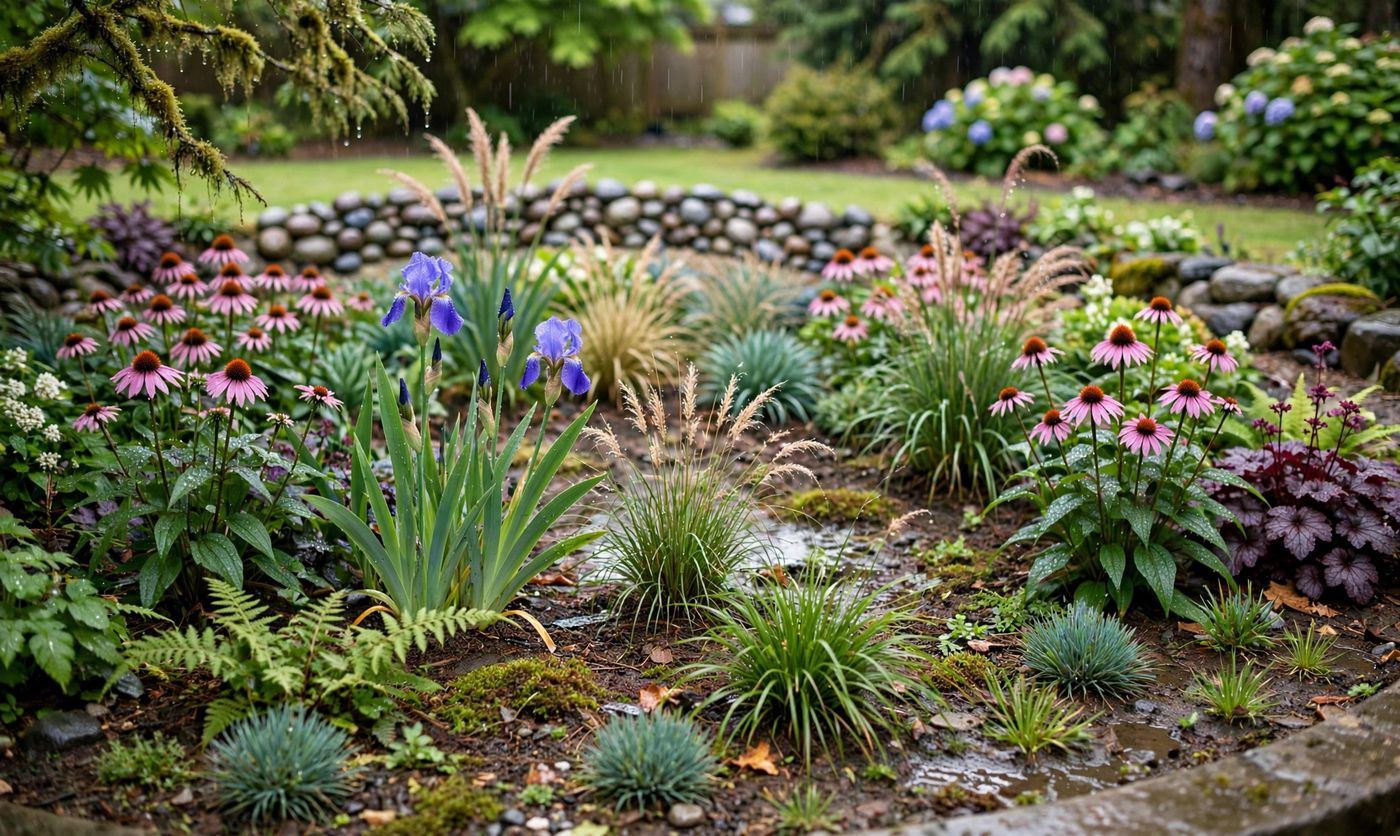
A rain garden is a beautiful solution to an ugly problem: the puddle that never dries, the downspout that floods the path, the slope that washes mulch into the street every November. It is a shallow basin — usually 4 to 8 inches deep — planted with species that love wet feet in winter and tolerate dry summers. Stormwater soaks in within a day or two instead of running to the storm drain, and the planting looks like a lush meadow bed the rest of the year.
In a region with our rainfall, a rain garden is one of the highest-impact projects a yard can take on: it recharges groundwater, filters runoff, and turns a drainage liability into the most alive corner of the garden — frogs, dragonflies and birds find it fast.
Design moves that make it work
- Site it at least 10 feet from foundations, where water already wants to go; a simple percolation test (a dug hole should drain in 24–48 hours) confirms the spot.
- Zone the planting: true moisture-lovers (sedge, iris, rushes) in the basin floor, tolerant plants on the rim.
- Size the basin to your roof area — roughly 10–20% of the drained surface is the usual rule of thumb.
- Mulch with washed gravel or coarse bark that will not float away in the first storm.
Plant combinations that work
Individual plants are easy; combinations are the design. Three proven groupings for this style — and how each one sits in the layout:
- The basin floor — Slough sedge, Common camas, Western columbine. Sedges drink the stormwater, camas blooms blue in spring, columbine feeds the hummingbirds after.
- The wet-edge ring — Red osier dogwood, Western sword fern, Oregon grape. Dogwood and Oregon grape on the rim for structure and winter stems, ferns filling the damp shade.
- The meadow basin — Shenandoah switch grass, Common camas, Slough sedge. Grass for late-season height, camas for spring, sedge doing the quiet work of soaking it all in.
Signature plants
From the YardCanvas Pacific Northwest plant library — 28 plants carry the Rain Garden style:
- Mahonia repens Mahonia repens
- Pennisetum alopecuroides ‘Moudry’ Pennisetum alopecuroides
- Polystichum munitum Polystichum munitum
- Blechnum spicant Blechnum spicant
- Cornus stolonifera ‘Kelseyi’ Cornus stolonifera
- Symphoricarpos albus Symphoricarpos albus
- Mahonia aquifolium Mahonia aquifolium
- Ribes sanguineum Ribes sanguineum
- Camassia quamash Camassia quamash
- Lavandula angustifolia ‘Hidcote’ Lavandula angustifolia
Browse the full Plant Library for sizes, sun and water needs.
In the Pacific Northwest
PNW rain gardens earn their keep November through March and must survive August dry — that wet-dry swing defines the palette. Native sedges, tufted hairgrass, camas and Oregon iris are built for exactly this cycle and need no irrigation once established.
Maintenance, honestly
No garden is no-maintenance. Here is the real rhythm for this style, season by season:
- Spring: Clear winter debris from the basin and check the inflow and overflow paths.
- Summer: Water only in year one; after that the basin palette is on its own, wet or dry.
- Fall: Cut back nothing until spring — stems slow stormwater and shelter insects.
- Winter: Check after big storms that water ponds and drains within a day or two, as designed.
Getting the layout right
Because levels matter — inches decide whether a rain garden ponds or floods — YardCanvas plans it on the measured layout with the basin, overflow path and plant zones drawn before anything is dug.