
Blog · Garden style guides
Shade Garden Plants
Shade garden design for the Pacific Northwest.
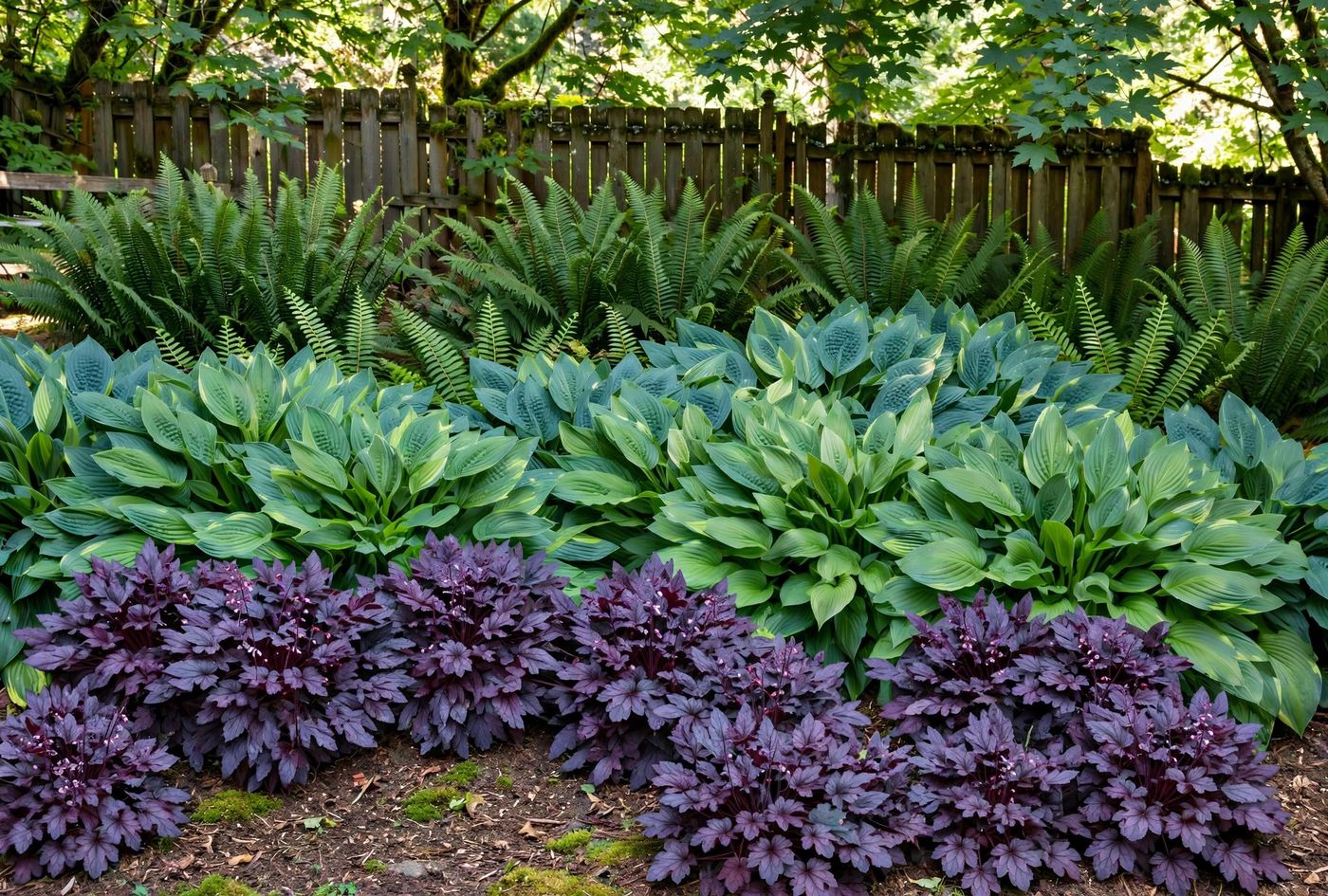
Every yard has the spot where grass sulks and nothing blooms — the north side, the corner under the big maple, the strip the fence shadows all day. A shade garden treats that spot as an asset. Without harsh sun, foliage becomes the flower: hostas in blue, gold and giant green, fern fronds in layers, astilbe plumes, bleeding hearts, and coral bells in purple and silver. Shade gardens are the lushest gardens of all, because nothing gets scorched and the soil stays cool and moist.
The design language is texture and light. Pale and variegated leaves are placed where they catch what sun there is, deep greens fill the back, and a winding path or a few stones give the eye somewhere to travel. It is the most peaceful style in the catalog — a green room.
Design moves that make it work
- Read your shade honestly: bright shade (open sky, no direct sun) grows almost anything on the list; deep dry shade under conifers is the hard case — plant ferns, epimedium and sarcococca there.
- Lead with foliage: combine bold (hosta), fine (fern), glossy (sarcococca) and colored (coral bells) leaves in every view.
- Put the lightest foliage at the back of a dark corner; it visually pulls the corner forward.
- Water new plantings well the first year — shade under trees is often dry shade, because the canopy drinks first.
Plant combinations that work
Individual plants are easy; combinations are the design. Three proven groupings for this style — and how each one sits in the layout:
- The lush trio — Hosta, Deer fern, Amethyst Mist coral bells. Bold hosta leaves, fern texture behind, coral bells edging — the shade garden's greatest hits in one layered drift.
- The spring shade show — Astilbe, Bleeding heart, Ajuga. Bleeding heart opens in April, astilbe plumes follow in June, ajuga carpets the ground blue in between.
- The dark-corner fix — Hosta, Tassel fern, Dwarf sweet box. For the corner nothing else wants: glossy sweet box at the back, ferns mid-layer, pale hostas pulling light forward.
Signature plants
From the YardCanvas Pacific Northwest plant library — 36 plants carry the Shade Garden Plants style:
- Mahonia repens Mahonia repens
- Arbutus unedo ‘Compacta’ Arbutus unedo
- Mahonia nervosa Mahonia nervosa
- Bergenia cordifolia ‘Winterglow’ Bergenia cordifolia
- Pachysandra terminalis Pachysandra terminalis
- Pieris japonica ‘Prelude’ Pieris japonica
- Heuchera x ‘Amethyst Mist’ Heuchera x
- Blechnum spicant Blechnum spicant
- Cornus stolonifera ‘Kelseyi’ Cornus stolonifera
- Helleborus orientalis Helleborus orientalis
Browse the full Plant Library for sizes, sun and water needs.
In the Pacific Northwest
The Pacific Northwest is shade-garden country: our native sword fern, Oregon grape, salal and vanilla leaf can carry a whole bed, and hostas grow to sizes here that make other regions jealous. Slugs are the tax — choose thick-leaved hostas, keep debris cleared, and the damage stays minor.
Maintenance, honestly
No garden is no-maintenance. Here is the real rhythm for this style, season by season:
- Spring: Mulch with leaf compost; divide hostas as the pips emerge.
- Summer: Water in dry spells — shade under trees is drier than it looks; watch for slugs.
- Fall: Leave the leaves where they fall (off hosta crowns) — free mulch and insect habitat.
- Winter: Cut fern fronds only when new ones unfurl in late winter.
Getting the layout right
Shade changes through the day and the year, so YardCanvas maps the actual shadow line of your yard onto the plan and places deep-shade plants only where the deep shade truly is.