
Blog · Garden style guides
Steep Slope Plantings
Steep slope planting design.
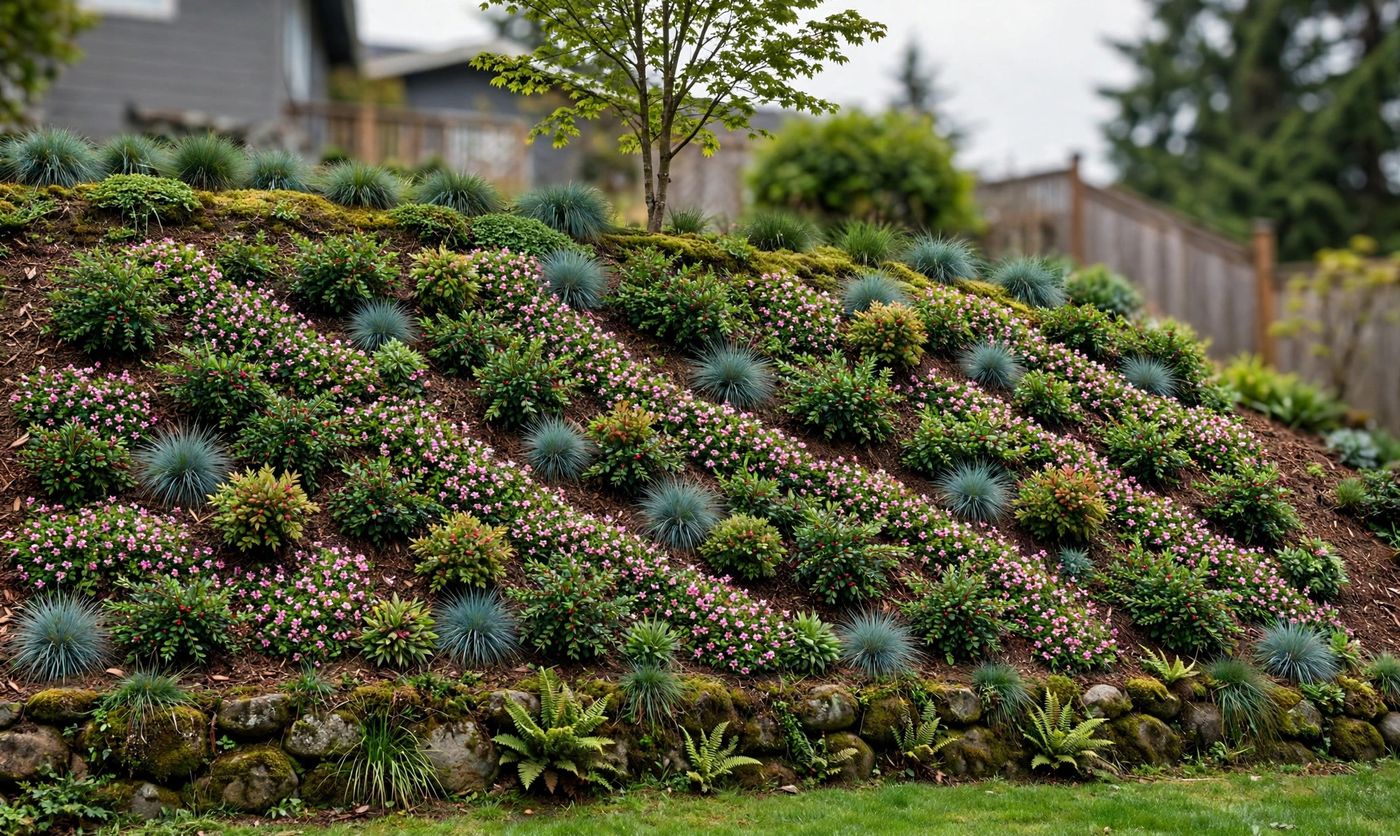
A steep slope is the yard problem that mowing makes worse and rain makes dangerous. Planting is the fix — but the right planting, in the right pattern. Slope plantings work like a net: deep and fibrous roots from grasses and groundcovers stitch the surface, shrub roots anchor deeper, and the canopy of leaves breaks the rain before it can move soil. Planted on contour in staggered rows, a slope garden turns an erosion liability into one of the most dramatic plantings in the yard.
The style has its own beauty: waves of kinnikinnick and cotoneaster, grasses moving across the bank, a few small trees punching out of the slope. It is also genuinely low maintenance once covered — a planted slope needs no mowing, ever, which on a 30-degree bank is reason enough.
Design moves that make it work
- Plant on contour in staggered rows, never in lines running downhill — vertical lines become water channels.
- Lead with the groundcover army (kinnikinnick, cotoneaster, creeping sedum, grasses) at tight spacing; coverage speed is erosion control.
- Anchor with shrubs and a few small trees whose roots go deeper than the groundcover mat.
- Water with drip or soaker lines laid along the contour — sprinklers on a slope mostly water the bottom.
Plant combinations that work
Individual plants are easy; combinations are the design. Three proven groupings for this style — and how each one sits in the layout:
- The erosion net — Kinnikinnick, Elijah blue fescue, Lipstick beach strawberry. Groundcovers knitting the surface shut in staggered rows, grass roots stitching between them.
- The fast cover — St. John's Wort, Orange sedge, Kinnikinnick. Fast-spreading St. John's Wort takes the mid-slope, sedge stitches the channels, kinnikinnick finishes the toe of the bank.
- The native holder — Ocean spray, Western sword fern, Evergreen huckleberry. Ocean spray anchoring the top, huckleberry mid-bank, ferns and kinnikinnick sealing the surface — the slope that plants itself.
Signature plants
From the YardCanvas Pacific Northwest plant library — 19 plants carry the Steep Slope Plantings style:
- Arctostaphylos uva-ursi Arctostaphylos uva-ursi
- Carex testacea Carex testacea
- Mahonia nervosa Mahonia nervosa
- Polystichum munitum Polystichum munitum
- Fragaria chiloensis ‘Lipstick’ Fragaria chiloensis
- Symphoricarpos albus Symphoricarpos albus
- Festuca glauca ‘Elijah’ Festuca glauca
- Holodiscus discolor Holodiscus discolor
- Mahonia aquifolium Mahonia aquifolium
- Ceanothus ‘Julia Phelps’ Ceanothus
Browse the full Plant Library for sizes, sun and water needs.
In the Pacific Northwest
PNW slopes fail in winter rain, so coverage before November is the goal: plant in spring, mulch with coarse material that stays put (or jute netting on the steepest pitches), and our native kinnikinnick and salal are the proven long-term holders in zones 8b–9a.
Maintenance, honestly
No garden is no-maintenance. Here is the real rhythm for this style, season by season:
- Spring: Walk the slope after winter storms: replant any bare patch before it becomes a channel.
- Summer: Water new sections with soaker lines along the contour; established cover needs none.
- Fall: Top up coarse mulch or netting on thin spots before the rains.
- Winter: Inspect after big storms for rills or slumps and pin them down early.
Getting the layout right
Slope math is unforgiving — the true surface area of a bank is much larger than its footprint on a flat map. YardCanvas measures the slope's real dimensions, so plant counts and mulch volumes come out right the first time.