
Blog · Garden style guides
Xeriscape
Xeriscape design for the Pacific Northwest.
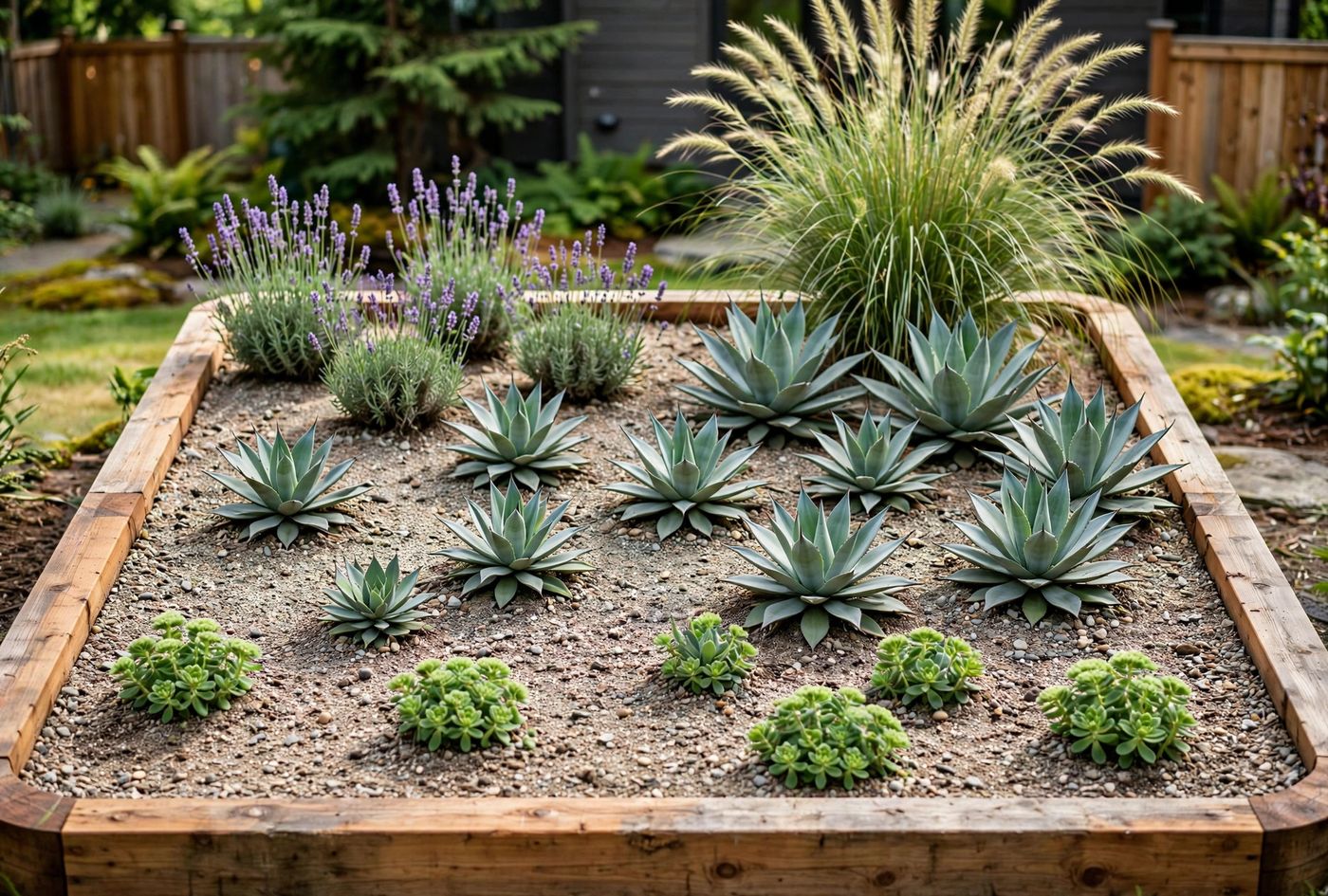
Xeriscaping means designing for low water — not for cactus and punishment. A good PNW xeriscape is lush in spring, architectural in summer, and nearly irrigation-free once established: lavender mounds, blue fescue and blue oat grass, sedum spilling over stone, penstemon and blanket flower for the bees, all sitting in gravel mulch that keeps roots cool and weeds down. It borrows its palette from Mediterranean and steppe plants that share our pattern of wet winters and dry summers.
The Pacific Northwest surprises people: our summers are genuinely dry — Seattle gets less rain than Miami in July — so water-wise design is not a desert affectation here, it is common sense. Lawns brown off every August; a xeriscape just looks intentional while doing it.
Design moves that make it work
- Fix drainage first: xeriscape plants need winter drainage even more than summer drought tolerance.
- Build the palette from proven dry-summer plants — lavender, rosemary, sedum, fescue, penstemon, rock rose — not desert plants that rot in winter wet.
- Use gravel or mineral mulch in the dry zones; bark holds winter moisture against crowns that want to stay dry.
- Water deeply the first season to establish roots, then taper; most xeriscape beds here run on rainfall alone by year two.
Plant combinations that work
Individual plants are easy; combinations are the design. Three proven groupings for this style — and how each one sits in the layout:
- The dry river — Lavender, Blue fescue, Sedum. Lavender mounds along a gravel run, fescue as blue punctuation, sedum stitching the edges — the xeriscape signature.
- The pollinator strip — Blue oat grass, Purple coneflower, Lamb's ear. Tall grass for structure, coneflower for the bees, silver lamb's ear cooling the front edge.
- The herb wall — Rosemary, Lavender, Sedum. Planted against a warm wall: rosemary as the shrub layer, lavender in front, sedum at its feet — all fragrance, no irrigation.
Signature plants
From the YardCanvas Pacific Northwest plant library — 43 plants carry the Xeriscape style:
- Arctostaphylos uva-ursi Arctostaphylos uva-ursi
- Arbutus unedo ‘Compacta’ Arbutus unedo
- Mahonia nervosa Mahonia nervosa
- Phlox subulata ‘Emerald Blue’ Phlox subulata
- Helictotrichon sempervirens ‘Saphirspruel’ Helictotrichon sempervirens
- Berberis thunbergii ‘Crimson Pygmy’ Berberis thunbergii
- Echinacea purpurea Echinacea purpurea
- Eryngium alpinum Eryngium alpinum
- Euphorbia characias ‘Humpty Dumpty’ Euphorbia characias
- Festuca glauca ‘Elijah’ Festuca glauca
Browse the full Plant Library for sizes, sun and water needs.
In the Pacific Northwest
The PNW twist is winter: cold, saturated soil kills more 'drought-tolerant' plants than summer drought ever will. Raised beds, gravel collars at the crown, and a sunny, free-draining spot are the whole secret. In zones 8b–9a the palette above is reliably hardy; tender Mediterranean herbs like rosemary do best against a warm wall.
Maintenance, honestly
No garden is no-maintenance. Here is the real rhythm for this style, season by season:
- Spring: Cut back winter-killed tips, top up gravel mulch, check the drip lines once.
- Summer: Little to none — a deep soak only in extreme drought, and only for young plants.
- Fall: Plant now for winter root growth; stop watering established beds.
- Winter: Keep crowns dry: clear soggy leaves off sedum and lavender crowns.
Getting the layout right
YardCanvas groups xeriscape plantings into hydrozones on the plan — dry plants together, thirstier accents near a tap — so the layout itself saves the water.